English



WILDEN APPLICATION GUIDE
WILDEN Pumps for Food and Beverage
Food applications need a documented cleaning strategy as well as a flow requirement. Product viscosity, solids, shear sensitivity and the way the pump drains after cleaning all matter. Define whether the process needs disassembly for cleaning or a validated clean-in-place arrangement.

Typical transfer duty
Sauces, syrups, beverages and other qualified food-transfer duties
Ingredient vessel → Hygienic transfer → Processing or filling
What to evaluate
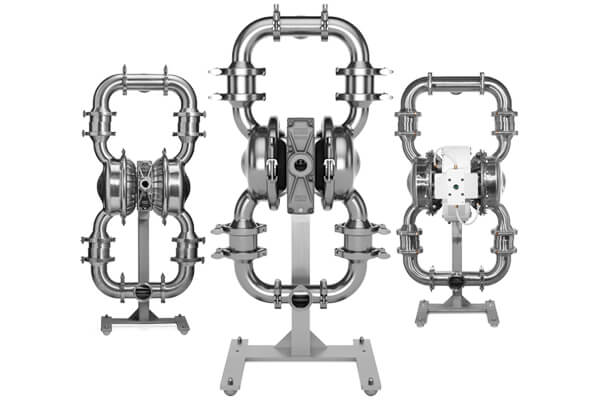
Compare Saniflo FDA and Saniflo Hygienic configurations. FDA Series and Hygienic Series are different designs; a food-contact material statement alone does not establish the cleaning capability of the assembled pump.
Selection checklist
Identify the exact food-contact materials
Review connections and drainage orientation
Match cleaning temperature and chemistry to all elastomers
Operating boundary
Verify the required declarations for the precise configuration. A stainless steel housing or sanitary connection does not, by itself, establish hygienic certification.
Maintenance and spare parts
Keep the complete WILDEN model code, installed diaphragm material and air distribution system in the maintenance record. Confirm air-kit and wet-kit compatibility separately. Follow the model-specific engineering, operation and maintenance manual for isolation, inspection, fastener torque and reassembly; a generic parts list is not a repair procedure.
Discuss your application
Send the fluid composition, concentration, temperature, viscosity, solids information, target flow, backpressure, suction conditions and available air supply. These details allow a meaningful configuration review and a matching spare-parts recommendation.
Explore WILDEN pumps · Repair kits · Request selection support
Editorial application guidance by Willee. Reference: Wilden Food and Beverage. This page describes an application, not a customer installation or a guaranteed operating result.